

A practical guide to choosing the right mixing technology
Six key decision factors to help (food) manufacturers identify the mixing technology that best fits their production process.
Six key decision factors to help (food) manufacturers identify the mixing technology that best fits their production process.
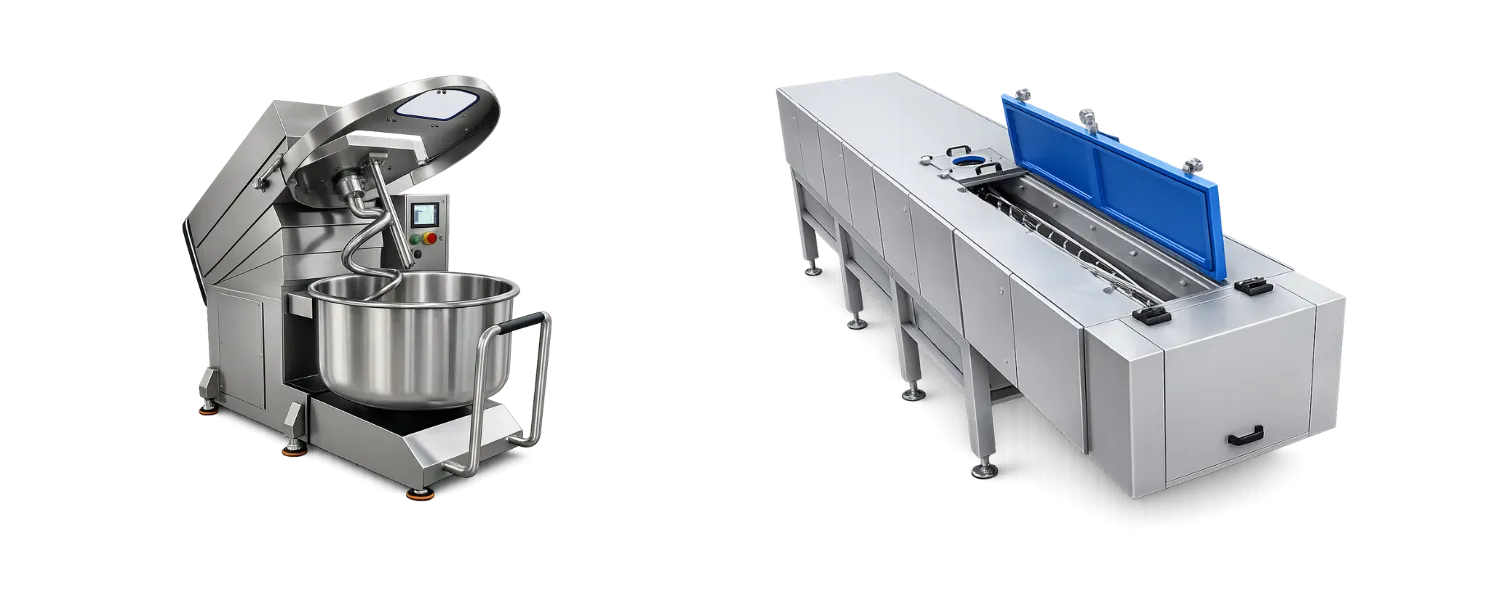
Choosing the right mixing technology is one of the most important deicisions in any food production process. Whether producing bread, tortillas, pizza, biscuits, snacks or other food products, the mixing stage has a direct impact on product quality, production efficiency and operating costs. As production volumes increase and labour becomes more difficult to find, many manufacturers begin asking the same question:
Should we continue with batch mixing, or is it time to switch to continuous mixing?
There is no universal answer.
The right choice depends on several factors, including production capacity, recipe flexibility, quality requirements and the desired level of automation. While batch mixing has been the industry standard for decades, modern continuous mixing systems have evolved into highly flexibile production solutions that offer exceptional consistency, reduced labour dependency and increased process control. This guide explains the key decision factors and introduces Sobatech's decision roadmap to help manufacturers determine which mixing technology best suits their production process.
Many manufacturers believe they have to choose between flexibility and efficiency. In reality, modern production systems often achieve both. The key is understanding how frequently major recipe changes occur and how much downtime those changes create.
Expert Tip
Twenty yeas ago, many food manufacturers selected a mixing system that remained in operation for decades with only minor modifications. Production volumes were relatively stable, labour was readily available and production portfolios changed at a much slower pace than they do today.
Today's production environment is very different. Manufacturers are expected to produce a wider variety of products, maintain increasingly consistent quality standards, respond quickly to changing customer demands and operate with fewer skilled operators than ever before. At the same time, rising costs and increasing competition require production facilities to become more efficient while maintaining the highest standards of food safety and traceability. As a result, many companies are taking a fresh look at one of the most fundamental stages in the production process: mixing.
The question is no longer simply whether the existing mixer is still capable of producing a good product. Instead, manufacturers are asking a much broader question:
Does our current mixing process still support the way we want to manufacture in the future?
The answer depends on much more than production capacity alone. It requires an understanding of the trends shaping modern food production and how these trends influence the choice between batch and continuous mixing technologies.
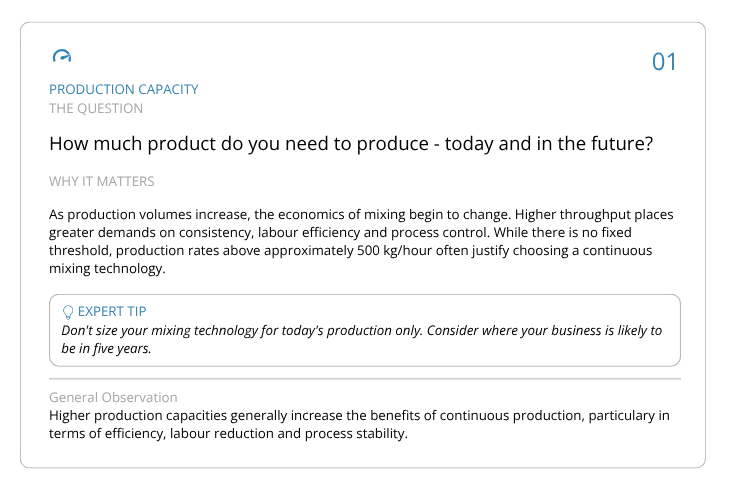
Many manufacturers are experiencing steady growth in demand. Existing production lines that once operated comfortably may now be running close to their maximum capacity, leaving little room for future expansion. As throughput increases, the economics of the mixing process begin to change, placing greater demands on process consistency, ingredient handling and production planning.
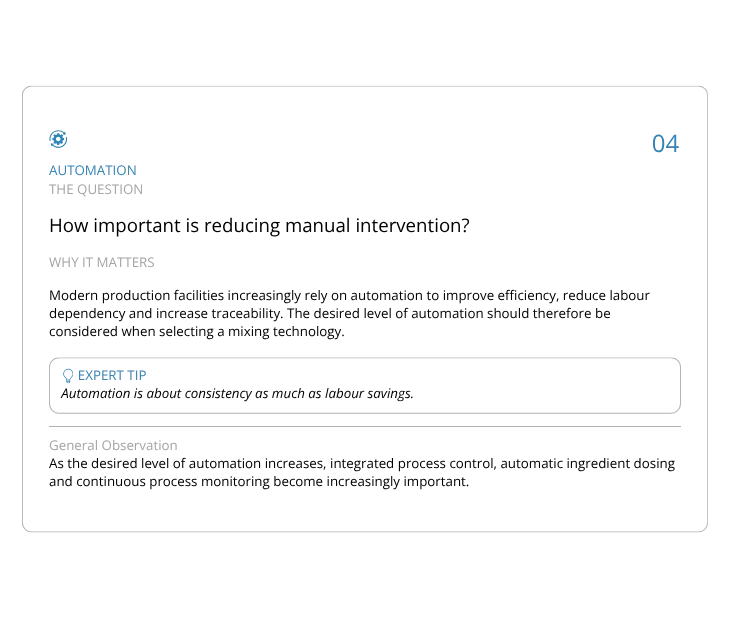
Finding experienced production operators has become one of the biggest challenges facing food manufacturers. As skilled labour becomes harder to recruit and retain, manufacturers increasingly look for production systems that reduce dependence on manual intervention. Modern automation can improve process stability while allowing operators to focus on monitoring rather than continuously adjusting production.
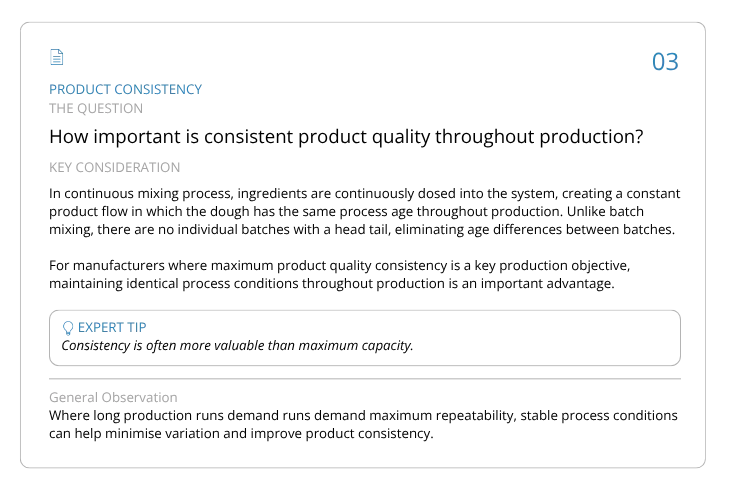
Consumers expect every product to look, taste and perform exactly the same every day. Even small variations during the mixing can influence downstream processes such as fermentation, proofing, baking or packaging, and as production volume increase, maintaining consistency becomes an economic necessity, not just a quality objective.
Food production is becoming increasingly data-driven. Modern facilities integrate recipe management, process monitoring and production reporting into central control systems, and expect greater visbility into ingredient dosing, recipe execution and process performance than ever before. The mixing process is no exception.
Reducing waste has become an important objective for both environmental and economic reasons. Ingredient losses, product rejects and inconsistent production all contribute to unnecessary costs. Manufacturers are seeking production methods that improve process stability, reduce variability and maximise the efficient use of raw materials.
When evaluating a mixing process, it is important to consider not only today's production requirements but also the direction in which the business is developing. Questions such as planned capacity increases, new product introductions, labour availability and future automation ambitions all influence which mixing technology will provide the greatest long-term value.
The objective is not simply to select a mixer that meets today's requirements, but to invest in a production process that continues to support the business as it grows.
The developments described in this chapter do not automatically mean that every manufacturer should switch to continuous mixing. Batch mixing remains the right choice for many production environments. However, these trends explain why more manufacturers are re-evaluating their current process and considering alternative technologies. The next chapter explain how batch mixing and continuous mixing actually differ in practice.
The previous chapter explored why many food manufacturers are re-evaluating their production process. The next step is understanding the two mixing technologies available today. Both batch mixing and continuous mixing have been successfully applied in food production for many years. Neither technology is inherently better than the other.
Batch mixing is the traditional mixing method used throughout the food industry. In a batch process, all ingredients required for a recipe are weighed and added to the mixer before the mixing cycle begins. Once the required mixing time has been completed, the entire batch is discharged and the mixer is prepared for the next production cycle. Each batch is therefore an individual production event.
This approach provides manufacturers with a high degree of flexibility. Different recipes can be produced one after another, making batch mixing particularly suitable for operations with frequent product changes or relatively small production volumes. Because each batch is prepared separately, operators also have the opportunity to inspect and adjust the process between batches when necessary.
Batch mixing is typically well suited for:
Each has its own strenghts and is designed to support different production strategies. The choice between the two should therefore not be based on the equipment itself, but on how well the technology supports the manufacturer's production objectives.
As production volumes increase, the characteristics that make batch mixing flexible can also introduce new challenges. Every new batch starts with a fresh dosing and mixing cycle, and small variations in ingredient weighing, operator actions or mixing conditions may lead to differences between batches. In addition, higher production capacities may require more frequent batching, greator operator involvement and more complex production planning
Flexibility is not measured by the number of recipes you produce. It is measured by the numer of major changeovers your production requires. Modern continuous mixing systems can handle many different recipes without interrupting production.
Expert Tip
Continuous mixing follows a fundamentally different production philosophy. Instead of producing individual batches, ingredients are continuously dosed into the mixing system while finished product leaves the mixer at the same rate. Once the process has stabilised, production becomes a continuous flow rather than a sequence of separate batches. The focus shifts from controlling individual batches to controlling a stable production process.
Modern continuous mixing systems continuously monitor ingredient dosing, mixing intensity and process conditions to achieve consistent product quality throughout the entire production run, allowing manufacturers to maintain stable prodction while reducing manual intervention and improving process repeatability.
Continuous mixing is typically well suited for:
Continuous mixing is often associated with large-scale production, but production capacity alone should not determine whether it is appropiate solution. Other factors, such as recipe flexibility, cleaning requirements and production planning, are equally important. Modern continuous mixing systems can accommodate a broader range of products than is often assumend, provided that changeovers are carefully considered during process design.
Continuous mixing should not be viewed as a replacement for batch mixing. It is an alternative production strategy designed to deliver maximum value in the right production environment.
Expert Tip
Although batch and continuous mixing operate differently, they share the same objective: to consistently deliver a high-quality product that meets the manufacturer's production requirements. The difference lies in how that objective is achieved. Batch mixing offers flexibility by producing one complete batch at a time, while continuous mixing achieves consistency by maintaining a stable, uninterrupted production process. Understanding these different production philosophies is fare more important than comparing machine specifications.
The next chapter introduces the six key decision factors that form the foundation of the Sobatech Decision Roadmap. A structured framework for evaluating which mixing technology is the most appropriate for a given application
.webp)
A successful mixing solution is rarely determined by a single factor. Instead, it is the result of balacing production requirements, operational flexibility and future business goals.
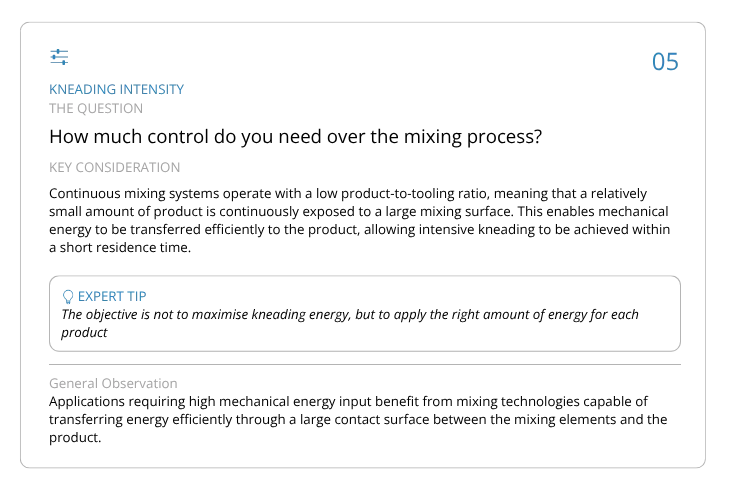
The following six questions form the foundation of the Sobatech Decision Framework
.webp)
.webp)
No single question determines the most suitable mixing technology. A manufacturer producing >500 kg/hour may still benefit from batch mixing if flexibility (through the possibility of dosing ingredients by hand) is the highest priority. Conversely, a manufacturer with lower production volumes may choose continuous mixing because product quality consistency and automation are critical. The best decision is made by considering all six factors together.
In the next chapter, these six questions are combined into the Sobatech Decision Roadmap, providing a practical framework to guide manufacturers towards the most suitable mixing technology for their production process.
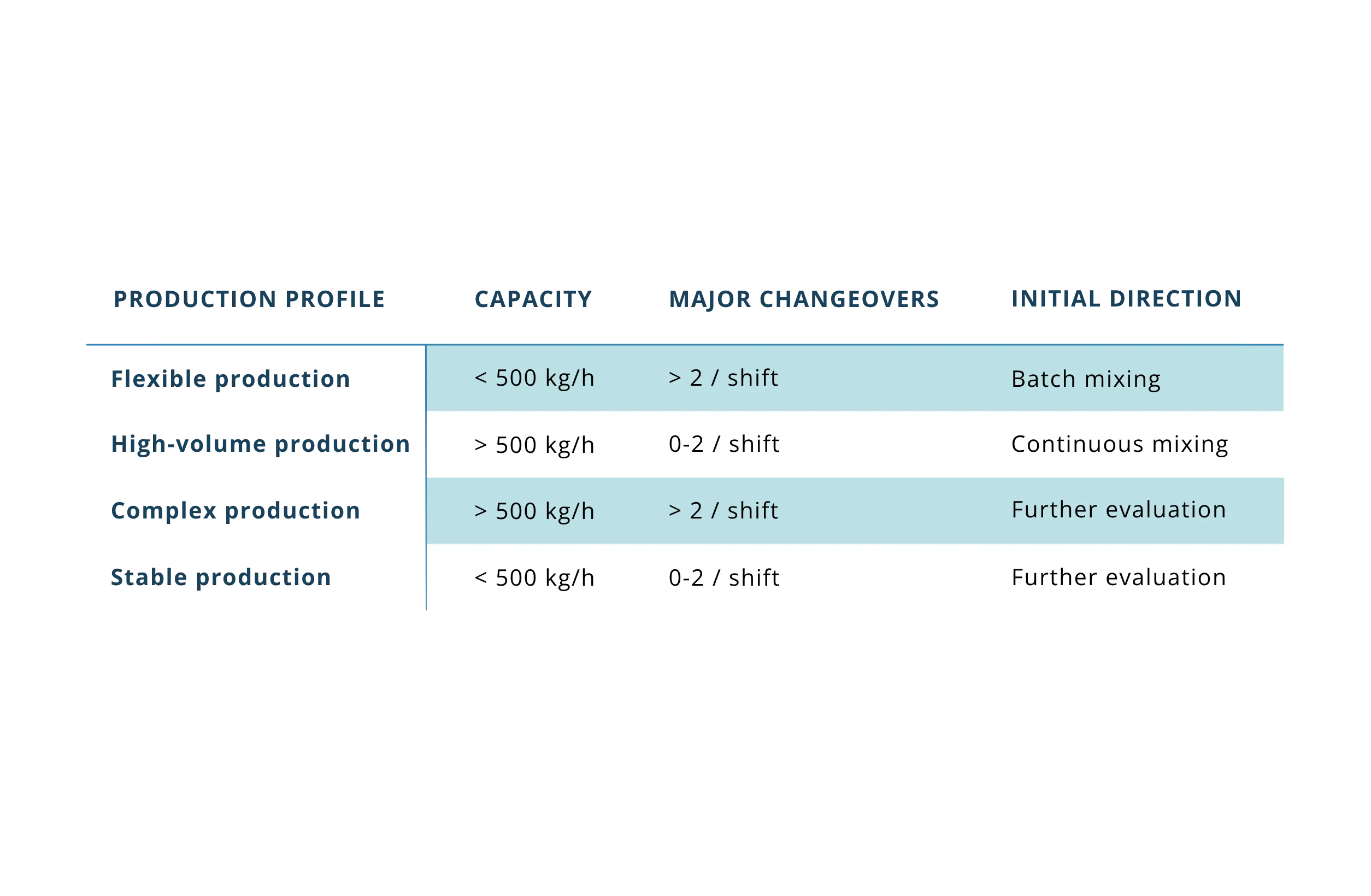
Choosing between batch and continuous mixing is rarely determined by a single factor. The Sobatech Mixing Decision Matrix provides a practical starting point by combining the two primary decision factors: production capacity and recipe flexibility.
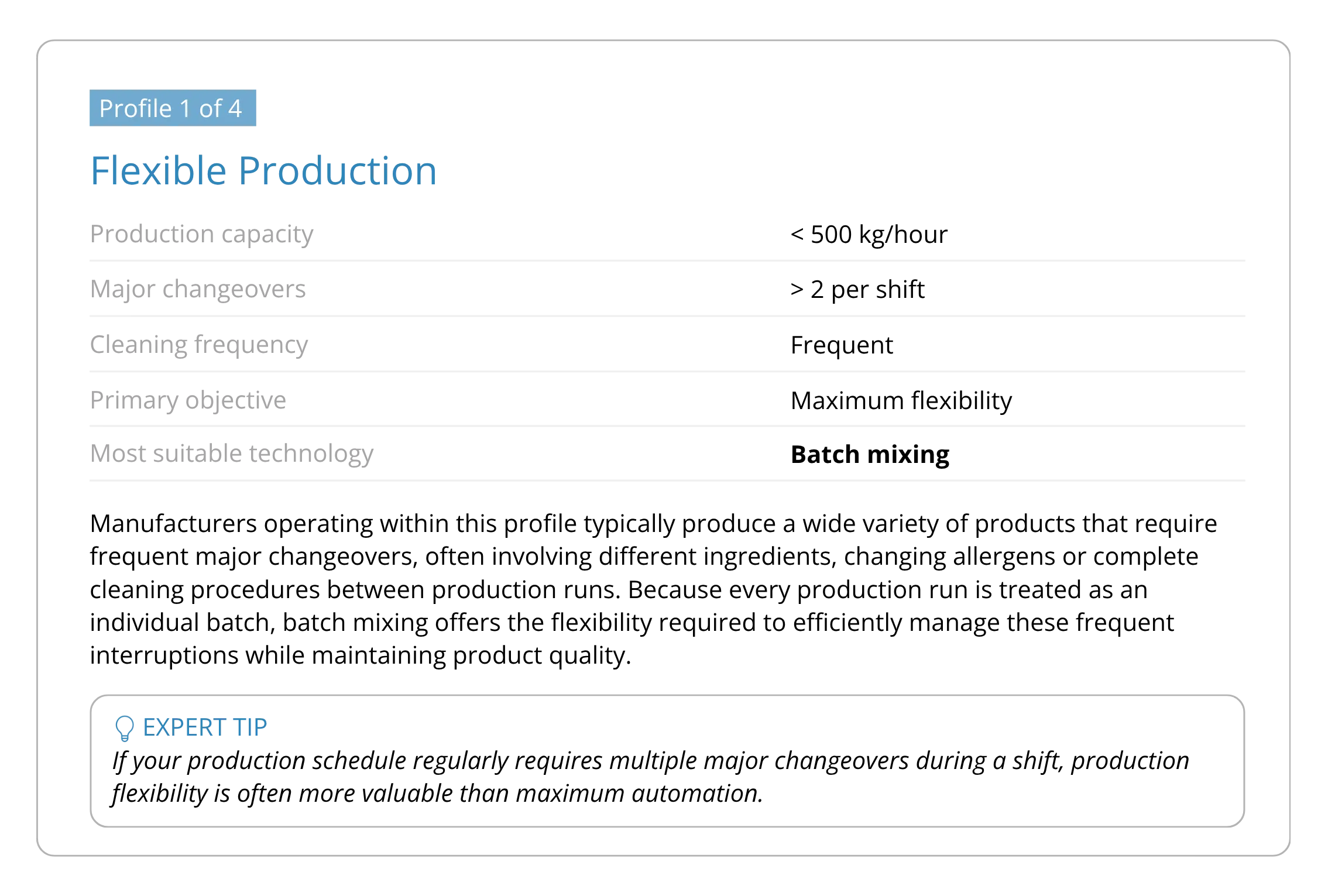
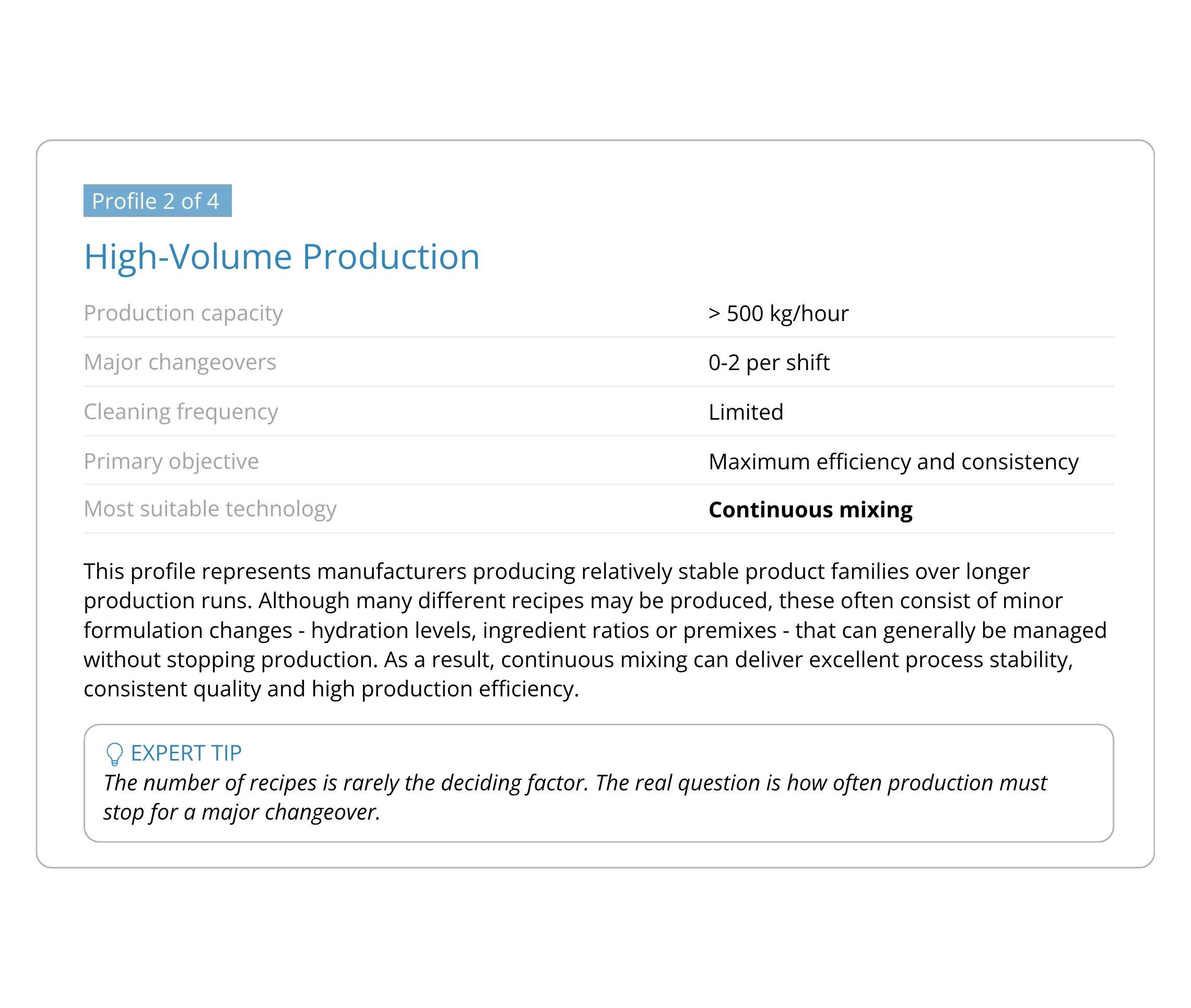
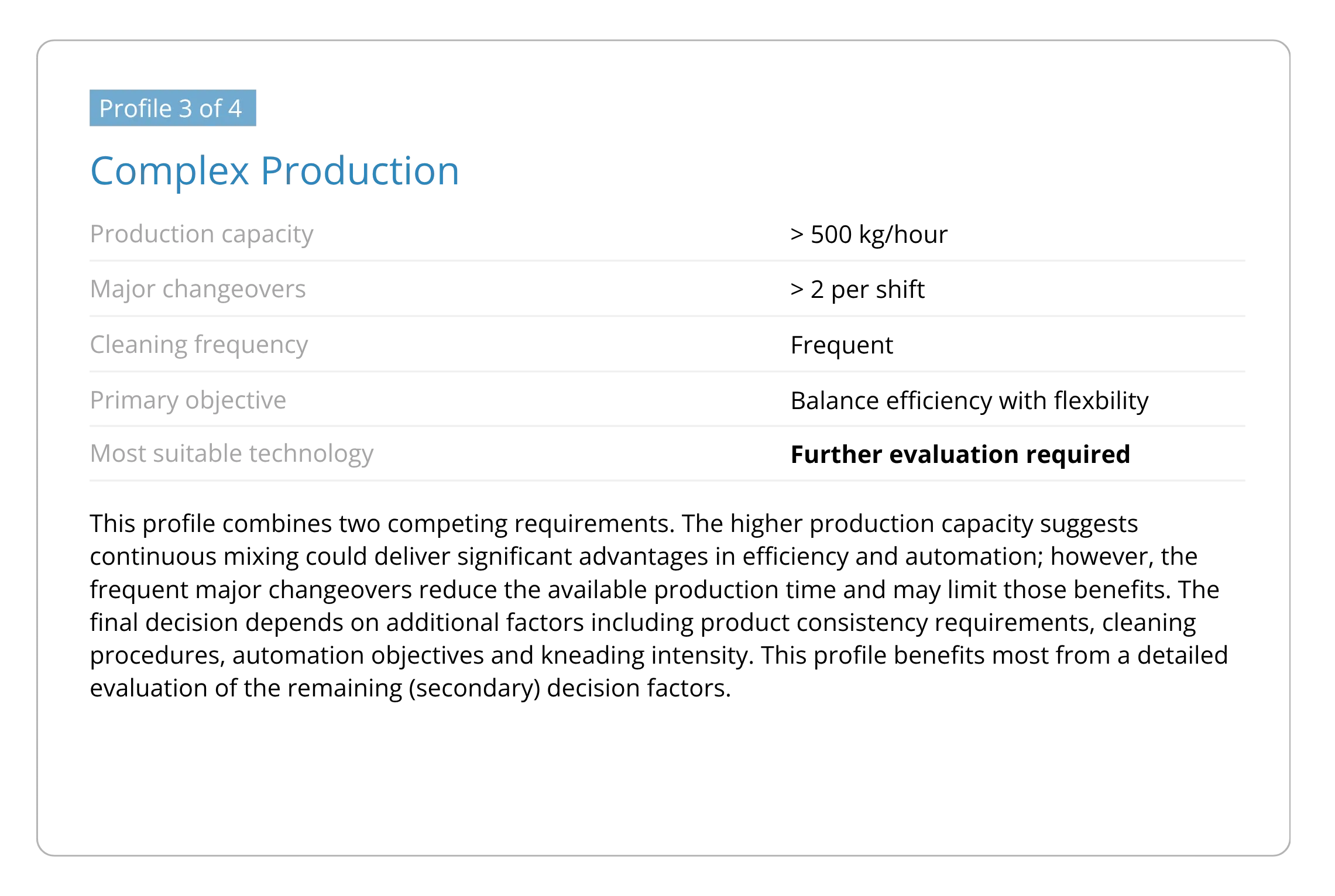
These factors create four typical production profiles. Two profiles usually point clearly towards one mixing technology, while the other two require further evaluation. The matrix is intended to provide an initial direction - the final decision should always consider all five decision factors together.
.webp)
Step 1 - Determine your production capacity. Identify the production capacity required today and in the foreseeable future. A throughput of approximately 500 kg/hour provides a useful reference point - not a strict technical boundary, but the point at which continuous mixing often becomes increasingly attractive.
Step 2 - Evaluate recipe flexibility. Consider how frequently production must stop for major recipe changes. Major changes may require full cleaning because of allergens, colours or substantial ingredient differences; minor formulation changes can often be managed without a complete shutdown. The key question is not how many recipes are produced, but how often major cleaning and changeover procedures are required.
Step 3 - Identify your production profile. The combination of capacity and recipe flexibility places the operation in one of four production profiles: Profile 1 usually favours batch mixing, Profile 2 usually favours continuous mixing, and Profiles 3 and 4 require a more detailed evaluation.
Step 4 - Evaluate the grey areas. Where the matrix does not produce an immediate answer, evaluate the remaining four decision factors: Product consistency, Automation, Kneading Intensity and Mixing Efficiency.
The grey areas are an important part of the matrix. They reflect the reality that mixing technology should be selected by evaluating the complete production process rather than relying on one fixed capacity threshold.
Expert Tip
The Sobatech Mixing Decision Matrix is designed to make the initial direction clear at a glance. It helps manufacturers identify whether their production profile is most likely to suit batch mixing, continuous mixing, or a more detailed technical and commercial evaluation.
The next chapter examines the four production profiles in greater detail and shows how the decision factors work together in practical manufacturing environments.
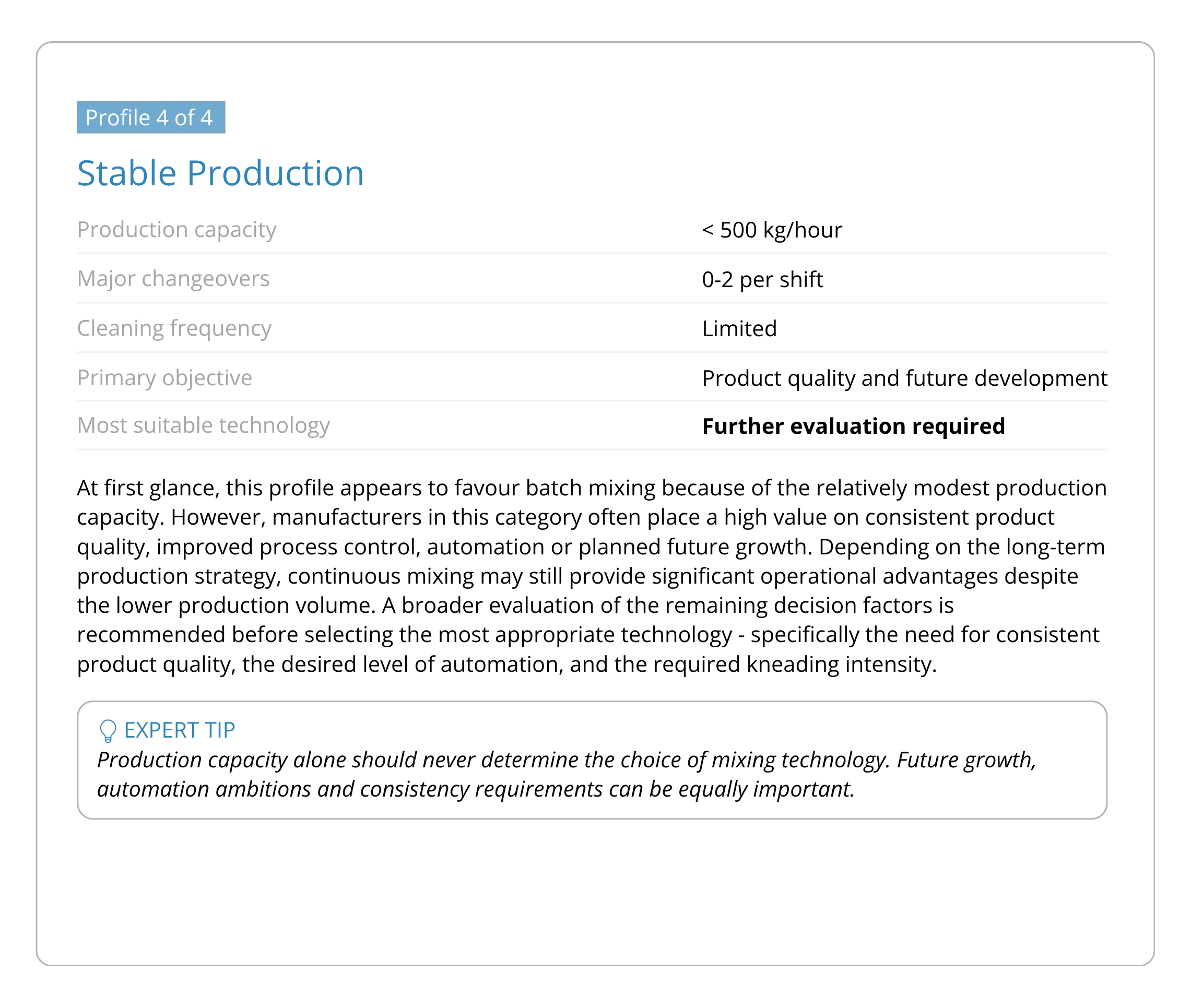
The Sobatech Mixing Decision Matrix provides a practical framework for evaluating whether batch mixing or continuous mixing is likely to be the most suitable technology. In practice, many manufacturers recognise their own operation in one of four typical production profiles. These profiles are not intended as strict classifications. Instead, they demonstrate how production capacity and changeover requirements work together to influence the choice of mixing technology.
Where a profile falls within one of the grey areas, the remaining decision factors - product consistency, automation and kneading intensity - should be evaluated before making a final decision.
The next chapter addresses common misconceptions about mixing technology and explains why some of the most frequently repeated statements are not always correct.
Choosing between batch and continuous mixing is not only influenced by technical requirements but also by long-standing assumptions. Many of these assumptions were true years ago, while others have simply been repeated so often that they are accepted as fact.
Modern mixing technologies have evolved considerably, making it worthwhile to challenge some of the industry's most common beliefs.


Many assumptions surrounding mixing technology are based on past experience rather than today's production reality. By evaluating measurable characteristics - capacity, major changeovers, product consistency, automation and kneading intensity - manufacturers can make informed decisions based on actual requirements rather than long-standing perceptions.
Key Takeaway
There is no universal best mixing technology. Selecting the right mixing technology is one of the most important decisions in the design and optimisation of a food production process. However, as this guide has demonstrated, there is no single solution that is universally superior.
Both batch mixing and continuous mixing are proven technologies capable of producing high-quality products. The most suitable choice depends on how well the technology supports the manufacturer's production process, operational objectives and future ambitions.
Throughout this guide, we have shown that six key decision factors form the foundation of every successful evaluation:
Rather than focusing on the mixing equipment itself, manufacturers should evaluate how these factors influence the overall production process. By considering the complete production environment, it becomes possible to select a solution that not only meets today's requirements but also supports future growth and changing market demands.
Modern continuous mixing technology can also provide benefits beyond production capacity alone. Improved mixing efficiency may contribute to more homogeneous ingredient distribution, greater process consistency and opportunities to optimise the use of functional ingredients such as dough improvers or premixes. These potential benefits should always be evaluated in relation to the specific production process and product requirements.
The Sobatech Mixing Decision Matrix and the four typical production profiles provide a practical framework for making this first assessment. While some production environments clearly favour batch mixing or continuous mixing, others require a more detailed evaluation of the complete production process. There is no substitute for understanding the specific needs of your operation.
Our experts are ready to help you optimize your production process.
Reach out today to discover how our continuous mixing systems can enhance your production process.